

Mon Jun 15 2026
...
React Native Commenting System SDK Update
! This Article Contains Technical Jargon
What's New
We just shipped version 5.1 of fastcomments-react-native-sdk, our React Native library that renders comments and chat with real native components instead of a WebView.
We rewrote the internals, redesigned the entire appearance, added a live chat widget, brought the SDK to the web, and upgraded it to the latest React Native and React.
Why Two React Native Libraries?
A quick note, because we get this question. We ship two options:
fastcomments-react-nativeis a thin wrapper around our web widget running in a WebView. It is the fastest way to get every feature instantly, and it benefits from web fixes automatically.fastcomments-react-native-sdk(this one) renders the UI with native React Native components without a webview. It is more flexible, fully themeable, and feels native because it is native.
For the best experience we recommend the SDK. The rest of this post is about what changed in 5.0.
New State Management
The primary driver of this change is to ensure our library stays true to our name and remains Fast. We had several customers complain about its performance, so this is now fixed.
The SDK originally kept its comment tree in Hookstate. It worked, but as threads and live updates grew things started to slow down.
We replaced Hookstate with Zustand and a flat, indexed store. Comments now reside in a byId map alongside childrenByParent, rootOrder, and pinnedIds indexes, instead of a tree nested inside state.
The payoff:
- Live events (a new comment, a vote, an edit) became O(1) mutations instead of walking and cloning a tree.
- We dropped two full-tree JSON deep-clones that used to run on every fetch.
- Components subscribe to exactly the slices they read, the standard selector model, so a vote on one comment touches only that comment.
That last point matters more than it sounds. With selector-based subscriptions, a row only re-renders when its own data changes.
A Token-Based Redesign
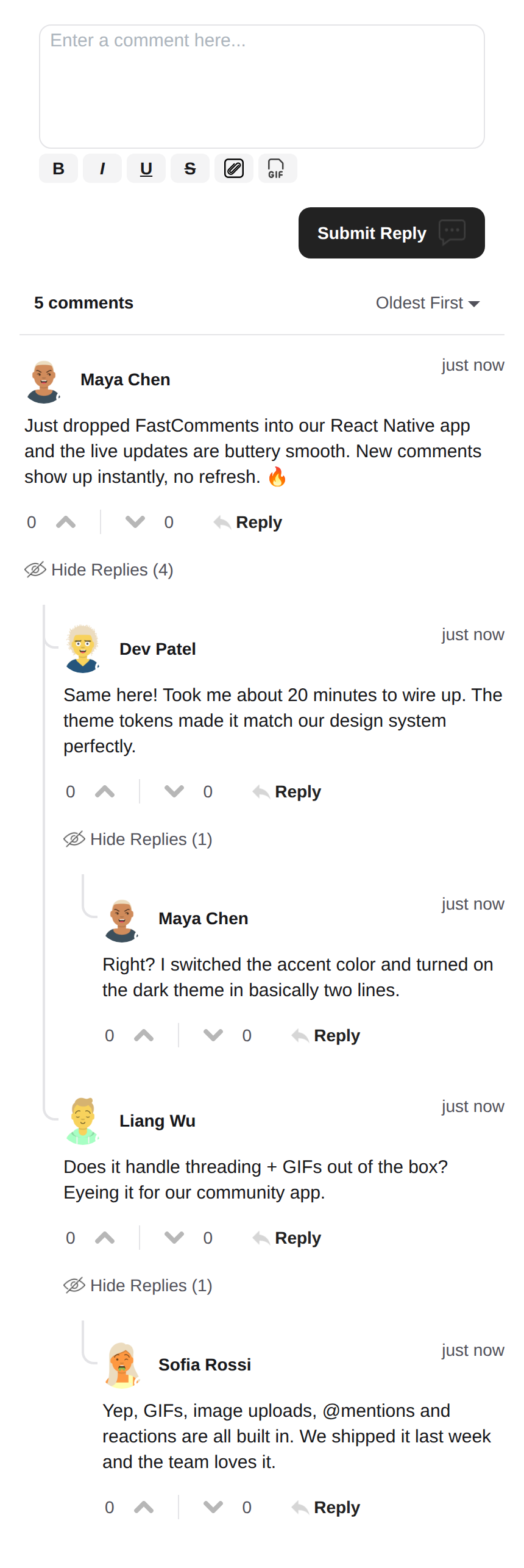
The old look was a pile of hardcoded styles. The new default is generated from a set of semantic design tokens (FastCommentsTheme): colors, spacing, radius, font sizes, font weights, and avatar sizes. The entire style tree is derived from those tokens.
That means restyling is one prop:
<FastCommentsLiveCommenting config={config} theme={{ colors: { primary: '#FF5500' } }}/>
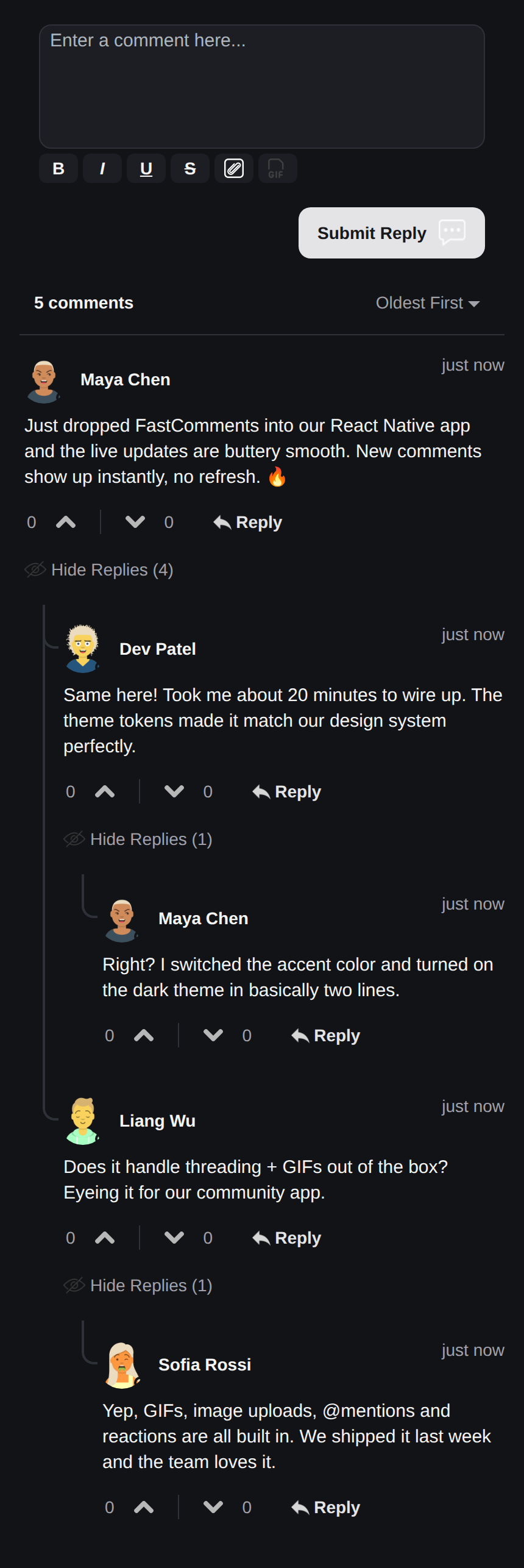
Dark mode is one token set away:
import { getDarkTheme } from 'fastcomments-react-native-sdk';

<FastCommentsLiveCommenting config={config} theme={getDarkTheme()}/>
The redesign itself is a cleaner, modern-neutral look: hairline separators, pill vote buttons and chips, filled primary buttons, rounded avatars, and a consistent type scale. The styles prop is still there for surgical overrides, so existing integrations keep working.
A Dedicated Live Chat Widget
We added FastCommentsLiveChat, a chat preset over the same engine that mirrors our Android SDK's chat view: chronological messages with the newest at the bottom, the composer below the list, a live header strip with a connection dot and user count, auto-scroll that pauses while you read older messages, and infinite history as you scroll up. Every preset is overridable through config.
<FastCommentsLiveChat config={{ tenantId: 'demo', urlId: 'my-room' }}/>
Now on the Web Too
The same SDK now runs on the web through react-native-web. The rich text composer (powered by react-native-enriched) renders the same way on iOS, Android, and the browser, so the editing experience is consistent everywhere with a single implementation. Overlays that the comment list would otherwise clip (menus, the GIF picker, the notification list) are anchored under their triggers on the web build.
You can try every widget yourself in the live component browser, which is this SDK running in the browser via react-native-web.
Keeping Current With React Native
5.0 is built and tested against React Native 0.81 and React 19, and it targets the New Architecture (Fabric), which the native rich text editor requires. Keeping current here is not busywork: the editor, the gesture handling, and the rendering all get faster and more correct as React Native moves forward, and we would rather take those upgrades steadily than fall years behind.
In Conclusion
This rewrite was about giving the React Native SDK the same first-class footing as our other libraries: a fast and predictable data model, a look you can theme in one prop, a chat widget, and web support, all on a modern React Native foundation.
You can find the SDK on NPM, the source, with examples, on GitHub, and every widget running live in the component browser. Let us know below if you run into anything.
Cheers!